
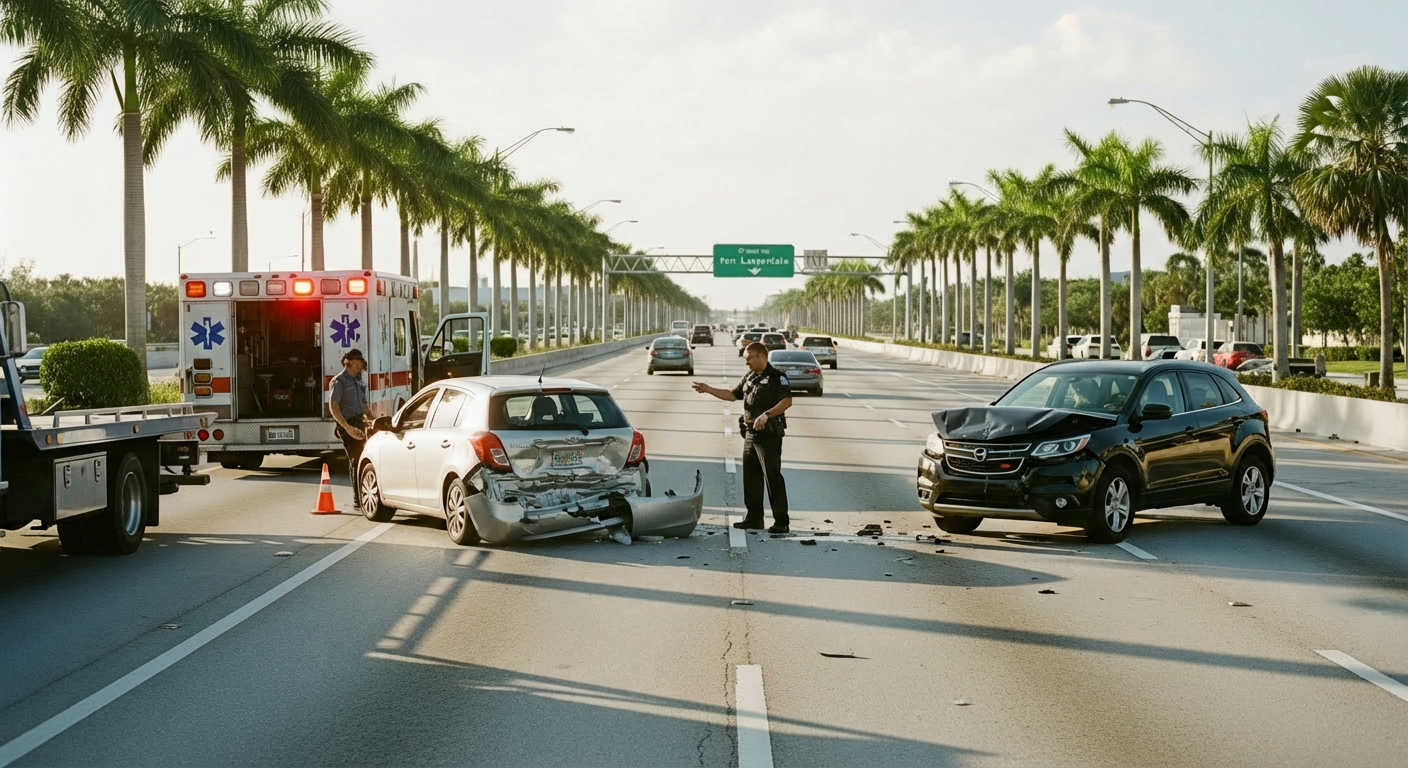
In most left-hand turn car accidents, the left-turning driver is presumed to be at fault. Florida traffic law generally requires drivers making a left turn to yield the right of way to oncoming traffic. When a collision occurs during that maneuver, fault often follows the failure to yield. However, this presumption is not absolute. Real-world crashes are rarely simple, and fault can shift or be shared depending on speed, signals, visibility, and the conduct of both drivers.
Left-hand turn accidents are among the most common and most dangerous crashes on South Florida roads. They frequently occur at busy intersections, during rush hour, or when a driver misjudges timing by just a few seconds. Understanding how fault is determined is essential not only for legal reasons, but also for protecting your financial future after a serious collision.
Who Has the Right of Way During a Left Turn?
Under Florida law, drivers turning left must yield the right of way to oncoming vehicles traveling straight through an intersection. This rule applies whether the intersection is controlled by traffic lights, stop signs, or is uncontrolled.
The logic is straightforward: vehicles traveling straight have priority because they are already established in the flow of traffic. The left-turning driver must wait until the turn can be made safely.
In most situations, the following drivers have the right of way:
- Drivers traveling straight through an intersection
- Drivers approaching on a green light while the left-turning driver has a solid green signal
- Drivers proceeding lawfully through uncontrolled intersections
For example, a driver in Fort Lauderdale approaches an intersection with a green light and continues straight. Another driver attempts a left turn across their lane and misjudges the distance. Even if both drivers had green lights, the turning driver was required to yield.
That said, right of way is not automatic immunity. Drivers with the right of way must still drive responsibly.
When is a Left-Turning Driver Considered at Fault?
A left-turning driver is typically considered at fault when they fail to yield and cause a collision. Florida courts and insurance companies often begin their analysis with that assumption.
Common situations where the left-turning driver is found at fault include:
- Turning across oncoming traffic without sufficient clearance
- Misjudging the speed of approaching vehicles
- Turning against a solid green without a protected arrow
- Failing to see an oncoming vehicle
However, fault is not always one-sided. Florida follows a comparative fault system, meaning responsibility can be shared. If the oncoming driver was speeding, distracted, or ran a red light, they may bear some or even most of the blame.
Imagine a scenario where a driver makes a left turn on a flashing yellow arrow, believing oncoming traffic has slowed. An approaching driver is speeding well above the limit and collides with the turning vehicle. In that case, fault may be divided between both drivers rather than assigned entirely to the person turning left.
Why Left Turns Across Traffic Are Especially Dangerous
Left turns are inherently risky because they require drivers to cross the path of oncoming traffic. Unlike right turns, which generally merge with traffic flow, left turns cut across it.
In South Florida, the danger is compounded by congestion, aggressive driving, and frequent distractions. A momentary lapse in judgment can result in a high-impact crash.
Factors that make left turns particularly dangerous include:
- Difficulty judging the speed and distance of oncoming vehicles
- Limited visibility due to other cars or weather
- Pressure from vehicles waiting behind the turning driver
- Driver impatience at busy intersections
According to traffic safety data, left-turn crashes are more likely to result in serious injuries because they often involve side-impact or head-on collisions. These types of crashes can cause significant harm even at moderate speeds.
Rules Governing Left Turns at Intersections in Florida
Florida law provides specific guidance on how and when left turns may be made. Florida Statutes require drivers turning left to yield to oncoming traffic that is close enough to pose a hazard.
Traffic signals also play a critical role. A protected green arrow allows a left turn without yielding, while a solid green requires yielding to oncoming traffic.
Key rules governing left turns include:
- Yielding to a solid green light
- Proceeding only when traffic is clear and safe
- Obeying protected turn arrows
- Avoiding turns when visibility is obstructed
Violating these rules often forms the basis for fault determinations after a crash. Police reports, traffic camera footage, and witness statements are commonly used to assess whether these rules were followed.
Situations Where the Oncoming Driver May be at Fault
Although the left-turning driver is often blamed, there are situations where the oncoming driver may be primarily or fully at fault.
Examples include:
- Speeding excessively through the intersection
- Running a red light or ignoring traffic signals
- Driving distracted or impaired
- Failing to use headlights at night or in poor weather
For instance, if an oncoming driver runs a red light while the left-turning driver has a protected arrow, fault may rest entirely with the oncoming driver. Similarly, excessive speeding can deprive the left-turning driver of the opportunity to yield safely.
These scenarios highlight why fault analysis must look beyond assumptions and focus on evidence.
How Evidence is Used to Determine Fault
Determining fault in a left-hand turn accident often depends on evidence gathered shortly after the crash. The clearer the evidence, the more accurately the fault can be assigned.
Common forms of evidence include:
- Police accident reports
- Traffic camera or surveillance footage
- Vehicle damage patterns
- Witness statements
In South Florida, intersections are increasingly monitored by cameras, which can provide valuable insight into signal timing and vehicle movement. Damage location also matters. Front-end damage to one vehicle and side-impact damage to another often supports a left-turn fault theory, but it is not conclusive on its own.
Steps to Take After a Left-Turn Accident
What you do after a left-turn accident can significantly affect how fault is determined and how your claim proceeds. The moments after a crash are stressful, but taking the right steps can protect your position.
Important steps include:
- Calling law enforcement and requesting a report
- Seeking immediate medical attention
- Photographing the scene and vehicle damage
- Obtaining witness contact information
- Avoiding admissions of fault
For example, apologizing at the scene may feel polite, but it can be misinterpreted later. Let the investigation determine fault based on facts, not emotions.
How Compensation is Affected by Fault in Florida
Florida’s comparative fault system allows injured parties to recover compensation even if they share some responsibility. However, compensation is reduced by the percentage of fault assigned.
If a driver is found 20 percent at fault, their compensation is reduced by that amount. This makes accurate fault determination especially important in left-turn accidents, where shared responsibility is common.
Compensation may include:
- Medical expenses
- Lost income
- Property damage
- Pain and suffering
When disputes arise, legal advocacy can help ensure fault is not unfairly shifted onto the injured party.
Why Left-Turn Fault Disputes Often Lead to Insurance Conflicts
Insurance companies are keenly aware that left-turn accidents often involve gray areas. As a result, they may attempt to minimize payouts by exaggerating the turning driver’s responsibility.
This is particularly true in serious injury cases, where the financial stakes are high. Without a clear understanding of Florida law and the evidence, injured drivers may accept less than they deserve.
.
How Ace Your Case Supports Injured Drivers After Left-Turn Accidents
Left-turn accidents are rarely just about traffic rules. They are about injuries, lost stability, and sudden uncertainty. Ace Your Case helps South Florida drivers navigate these moments with clarity and purpose.
Understanding who had the right of way is only the beginning. Properly presenting evidence, challenging unfair fault claims, and pursuing full compensation all require careful attention to detail and timing.
A Difficult Reality, and a Way Forward
A left-hand turn accident can change everything in seconds. One moment you are driving through a familiar intersection, and the next you are dealing with pain, medical appointments, and questions about fault that feel overwhelming. When fault is disputed, it can feel as though the system is working against you, especially when insurance companies move quickly to protect their interests.
After an accident, injuries can linger, finances can strain, and the stress of uncertainty can weigh heavily on daily life. Understanding how fault is determined and knowing that Florida law allows accountability even in shared-fault situations offers a path forward. With clear information, steady support, and the right steps taken early, it is possible to move from confusion to resolution, even after a devastating car crash. We are confident we can help.