
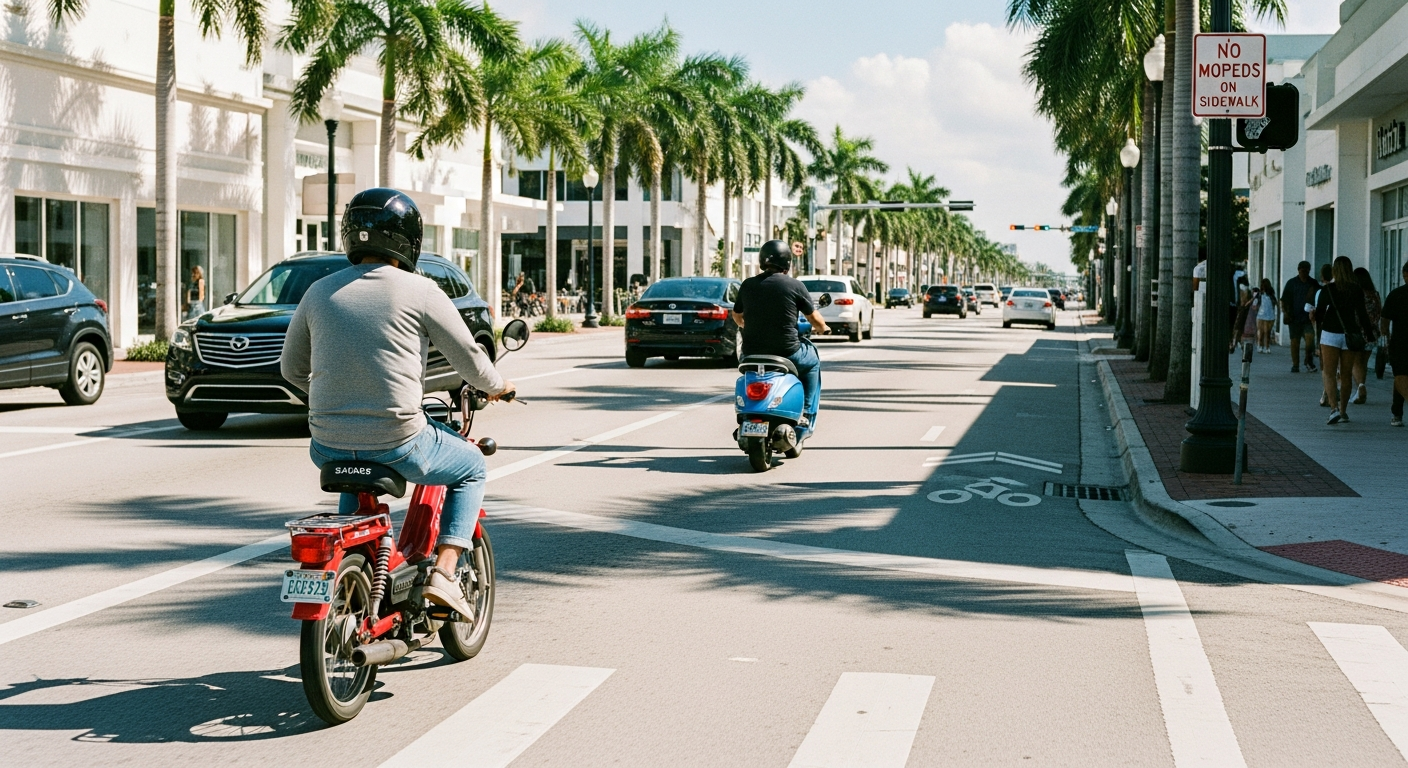
Mopeds are a familiar sight across South Florida, from quick rides along the Intracoastal to short commutes through downtown Fort Lauderdale and Miami Beach. They are affordable, fuel-efficient, and easy to park, which makes them appealing in a region built around sunshine and tight urban corridors. But Florida treats mopeds differently than motorcycles, scooters, and e-bikes, and those distinctions matter. If you ride a moped without meeting the proper rules for licensing, registration, or road use, you can face tickets, lose insurance protection, or put yourself at greater risk after a crash.
We can help you understand Florida moped laws in a clear, practical way. We can explain how the state defines a moped, what you need before riding on public roads, where you can and cannot ride, and what liabilities arise when rules are ignored. Whether you are a new rider in Broward County or someone returning to a moped after years off the road, understanding these requirements can keep you safer and help protect your rights if an accident happens.
Important Legal Considerations When Operating a Moped
Florida’s legal definition of a moped is specific, and it is the first thing you should verify before you assume your vehicle qualifies. Under Florida law, a moped must generally have pedals for human propulsion, a seat or saddle, no more than three wheels, a motor rated at 2 brake horsepower or less, and a top speed of no more than 30 miles per hour on level ground. If it uses a gas engine, it cannot exceed 50 cubic centimeters. Vehicles that look like mopeds but exceed these limits are treated as motorcycles or motor scooters, triggering stricter licensing and insurance requirements.
That classification is not academic or theoretical. It determines what you must carry to ride legally, and it can shape fault and coverage after a collision. In South Florida, riders often buy 50cc “scooters” marketed casually as mopeds. If that vehicle lacks pedals or exceeds 30 mph, it may not qualify as a moped at all, even if it was sold as one.
Before you ride, confirm three things:
- Your vehicle fits the statutory moped definition.
- Your licensing status aligns with that definition.
- Your registration and equipment meet Florida’s roadway requirements.
For a current state overview of these vehicle categories, Florida Highway Safety and Motor Vehicles provides detailed guidance.
Understanding the Basic Road Rules and Requirements for Moped Riders
Once your vehicle qualifies as a moped, Florida still requires certain basics before you take it on public roads. Unlike a motorized scooter or many e-bikes, a moped must be registered and must have a visible license plate. Florida does not require a title for mopeds, but registration is mandatory if you ride on streets or highways.
Florida also requires moped operators to have a valid driver’s license. You do not need a motorcycle endorsement for a true moped, but you must be at least 16 years old and properly licensed to ride on public roads. This is a critical difference from some micromobility devices, which do not require a license.
Practical road rules for South Florida moped riders include:
- Follow the same traffic laws as other road vehicles.
- Ride as far right as is safe unless turning or avoiding hazards.
- Use bike lanes only when moped operation is permitted and safe.
- Obey speed limits; the vehicle’s design speed does not exempt you.
- Yield properly at crosswalks and intersections.
Florida law also prohibits operating a moped motor on sidewalks. You may push a moped as a pedestrian in certain areas, but riding it under power on a sidewalk is not allowed. In dense pedestrian zones like Las Olas, Ocean Drive, or the Riverwalk, this rule is enforced more often than riders expect.
Imagine a rider commuting through Wilton Manors on a 50cc bike that can reach 38 mph and has no pedals. The rider assumes it is a moped and rides with a Class E driver’s license but no motorcycle endorsement. After a crash, the investigating officer classifies the vehicle as a motorcycle, which can lead to citations for improper licensing and complicate insurance coverage. A small classification mismatch can therefore become a significant legal problem.
Helmet Rules and Safety Equipment in Florida
Florida’s helmet rules for mopeds are age-based. Riders who are 16 or older are not automatically required to wear a helmet on a moped, but anyone under 16 must wear protective headgear that meets federal safety standards. Even when not legally required, helmets remain one of the few proven defenses against traumatic brain injury, which is a leading cause of serious harm in South Florida moped crashes.
Beyond helmets, Florida expects mopeds to be equipped for visibility and control. While equipment requirements can vary slightly by vehicle type, mopeds should have working brakes, working lights for night riding, and safe tires. In a region where afternoon storms reduce visibility quickly, proper lighting is not optional in practice, even if a rider thinks of the trip as short.
Safety is also linked to positioning. Mopeds are smaller and lighter than cars, and they are regularly overlooked at intersections. Defensive riding habits, such as assuming drivers do not see you, slowing early at cross streets, and avoiding blind spots, reduce the risk of being struck.
Where You Can and Cannot Ride a Moped in South Florida
Moped riders in Florida can use most public roads where slower vehicles are permitted, but there are important limitations. Because mopeds top out at around 30 mph by law, they do not belong on high-speed controlled-access highways. In South Florida, that means mopeds should not be on roads like I-95, Florida’s Turnpike, or sections of I-595 where minimum speeds and traffic flow exceed what a moped can safely manage.
Local roads, neighborhood streets, many surface arterials, and properly designed bike lanes are where mopeds are most commonly legal and safe. Still, local ordinances may affect where mopeds can be parked or ridden in certain municipal zones. For instance, some cities restrict micromobility access to particular boardwalks or promenade areas. If you ride frequently in a beach corridor or downtown district, checking municipal rules can prevent avoidable citations.
Key location takeaways for riders:
- Avoid expressways and high-speed limited-access highways.
- Stay off sidewalks under power.
- Use roadways where your speed does not create a hazard.
- Follow posted signage regarding bike lane or shared path use.
These rules exist because speed differentials are dangerous. A moped traveling 28 mph on a road where traffic averages 55 mph creates risk for everyone, especially for the rider.
Insurance, Liability, and Injury Risks for Moped Riders
Florida does not require liability insurance for vehicles that meet the strict moped definition. That can sound convenient, but it comes with a serious implication: if an uninsured or distracted driver hits you, your financial protection may depend heavily on your own health coverage or optional policies you chose voluntarily.
Because Florida is a no-fault state for car accidents, PIP insurance often covers initial medical care after many roadway collisions. But moped collisions can fall into gray areas depending on the vehicles involved and how the crash is classified. If your moped is reclassified as a motorcycle after an accident, different coverage rules may apply.
From a personal injury perspective, mopeds also expose riders to physical risks. There is less mass protecting you, and South Florida collisions frequently involve:
- Left-turn impacts at intersections
- Doorings in urban parking corridors
- Rear-end crashes in traffic backups
- Sideswipes during lane changes
- Loss-of-control incidents on wet roads
These accidents can lead to fractures, head injuries, spinal trauma, or long-term soft-tissue damage. If a crash is caused by a negligent driver, you may have a claim for medical costs, lost income, and pain and suffering, whether you were on a moped, motorcycle, or bicycle. For riders exploring their rights after serious injuries, our firm’s resource on South Florida motorcycle-related claims provides context that often overlaps with moped cases.
What to Do After a Moped Accident in Florida
The steps you take after a moped crash can determine whether you recover fully or end up fighting unnecessary disputes. Due to the frequent confusion about moped classification, riders should document the vehicle and the crash scene carefully.
After a South Florida moped accident, prioritize:
- Calling 911 and getting medical care right away
- Photographing the moped, including pedals, engine markings, and speed labeling
- Taking wide and close-up photos of the scene and vehicle damage
- Getting the driver’s information and witness contacts
- Requesting a copy of the police report number
- Keeping all medical records, receipts, and work-loss documentation
Even if you think your injuries are manageable, do not “wait and see” for several days. Delayed treatment often leads insurers to argue that the pain came from something else. Consistent care keeps your health protected and your claim credible.
Riding Mopeds Lawfully and Safely
Mopeds can be a smart way to get around South Florida, but only when riders understand the legal limits on where and how they can be used. The differences between a moped, a scooter, and a motorcycle may seem small in a showroom, yet they become decisive on the road and after an accident. Ace Your Case represents injured riders and passengers across South Florida and sees the true cost of these misunderstandings when crashes happen.
If you ride a moped, you deserve the freedom it offers without being blindsided by preventable legal problems. And if someone else’s carelessness has already altered your life, you deserve a clear path to accountability. A collision on a moped is rarely minor in its consequences. It can reframe your finances, your health, and your sense of safety in a city you once navigated easily. Knowing the rules helps you avoid that outcome, and knowing your rights helps you respond when the worst happens.